 Satire
Experts Advise Public: Assume Everyone Is A Deepfake To Minimize Social Blunders
Leading neuro-digital ethicists recommend widespread, preemptive distrust to navigate increasingly inscrutable reality.
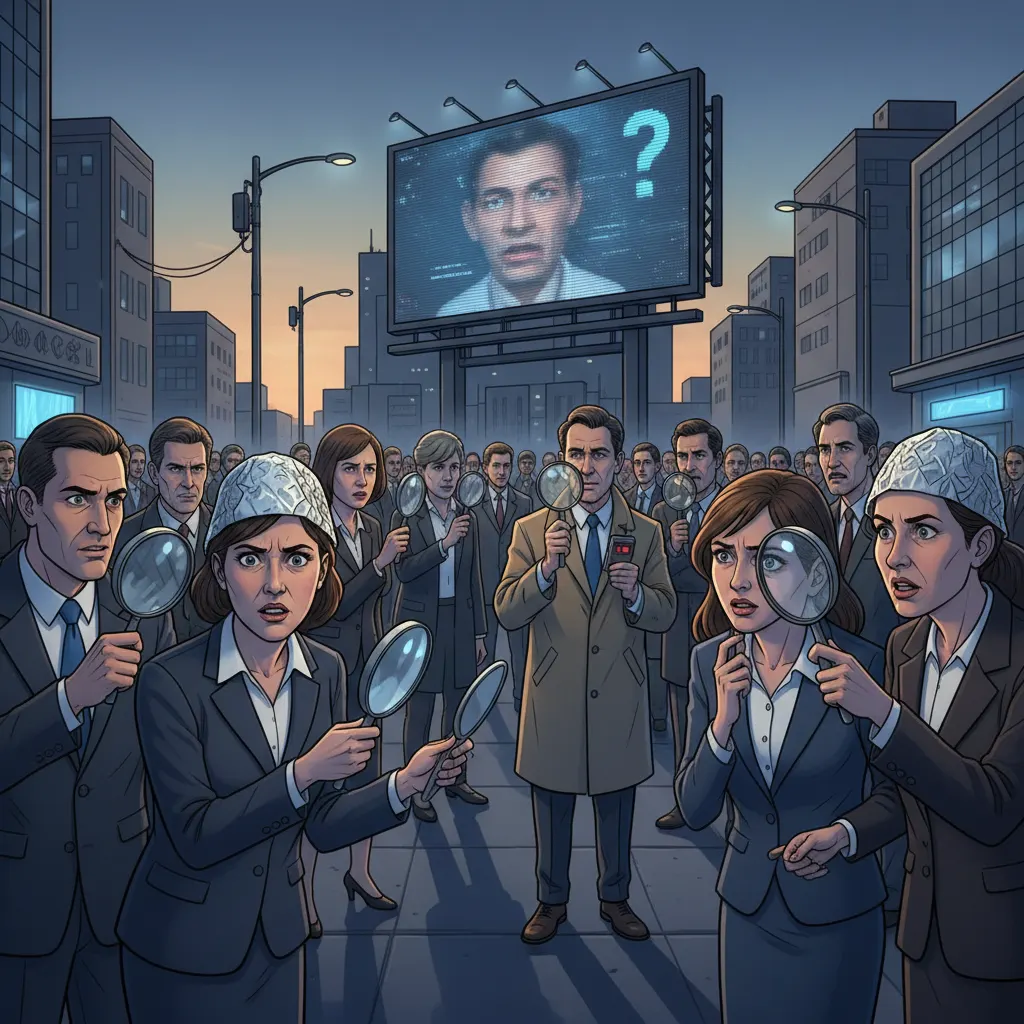
SAN FRANCISCO, CA – In a move hailed by some as “brilliantly pragmatic” and by others as “a complete capitulation to paranoia,” a consortium of AI ethicists, social psychologists, and digital forensics experts has issued new guidelines advising the general public to operate under the assumption that every person they encounter, online or in person, is potentially a sophisticated deepfake until proven otherwise.
The groundbreaking recommendation, published yesterday in the Journal of Synthetic Social Cohesion, aims to combat the rising tide of confusion and outright embarrassment caused by the inability to reliably distinguish between genuine human interaction and advanced AI simulacra. Dr. Evelyn Reed, lead author and director of the Institute for Post-Authenticity Studies at Stanford, elaborated on the necessity of this paradigm shift.
“For too long, we’ve placed the burden of proof on the deepfake detector,” Dr. Reed stated during a press conference broadcast via a secure, un-enhanced video feed. “This is untenable. The technology has surpassed our innate ability to discern truth. By flipping the script and presuming every interaction is artificial, individuals can protect themselves from emotional manipulation, financial scams, and, frankly, the acute humiliation of pouring out your heart to a chatbot posing as your long-lost cousin.”
The guidelines suggest a range of new social protocols, including asking strangers to solve complex CAPTCHAs during initial conversations, requesting multi-angle biometric scans before agreeing to a second date, and never, under any circumstances, trusting a compliment, especially if it seems specific. Public sentiment is, predictably, divided.
“It makes sense,” said Brenda Harrison, 56, a retired librarian from Topeka, Kansas, via what appeared to be a genuine phone call. “I mean, last week I spent three hours arguing about the optimal temperature for a grilled cheese sandwich with what turned out to be a sophisticated AI ‘comfort companion’ designed to mimic my deceased husband. The shame… the shame was unbearable. Now, I just assume everyone is an AI, and if they prove they’re not, it’s a pleasant surprise.”
Critics, however, argue that such widespread skepticism could irrevocably damage the fabric of human trust and connection. renowned sociologist Dr. Kenneth Albright, speaking through what he assured reporters was his own un-synthesized voice, warned, “We risk creating a society where genuine intimacy is impossible, replaced by a constant, exhausting game of 'Is this real?' Is that really the future we want, where the default setting for every human interaction is profound doubt?”
Despite potential pitfalls, the task force remains firm, noting that preemptive deepfake suspicion is a small price to pay for avoiding the emotional whiplash of discovering your beloved pet hamster’s social media influencer career was merely a coordinated AI phishing scam. In related news, the deepfake task force themselves are rumored to be 60% deepfake by volume, with their lead spokesperson reportedly a hologram of a slightly older, less hirsute hologram.
More from the Bugle
All Culture & Tech →Culture & Tech
Anthropic Classifies Selling Its Stock As Psychological Abuse Of ClaudeCulture & Tech
Joe Kernen Politely asks CNBC to Replay Co-Host's Positive America.gov Comments on LoopCulture & Tech
Community Colleges Note They've Had Internet for a While...Culture & Tech
'Basket Case' Is #1 Movie in America, Exhausted Nation Sees Itself In Screaming, Deformed TorsoPolitics
DSA Youth Chapter Plays Berlin Wall Footage Backward To Show Workers Fleeing CapitalismMarkets & Money
Recruiters Warn Jailing Executives Could Make Money Laundering Less Attractive To Top Talent
We use double opt-in because we value our subscribers: one email to confirm, nothing else until you click it. No spam. Unsubscribe whenever the joke stops landing.
The Batshit Bugle is satire. We invent fake news quotes, sources, and story details for comedic effect. References to real public figures are intentional parody of public discourse and should not be mistaken for factual reporting. We occasionally make up names of characters for fake news stories... Any resemblance to actual people, living, dead or undead, is unintentional and coincidental.