 Satire
Butthole-Shaped AI Logos Prompt Congressional Committee Emergency Session
Lawmakers sacrifice legislative agenda to tackle the pressing issue of unsettling digital anuses.
WASHINGTON D.C. – A bipartisan congressional committee met late into the night Wednesday to discuss what many are calling the most pressing national security threat since the advent of social media: the disturbing prevalence of butthole-shaped logos among artificial intelligence companies.
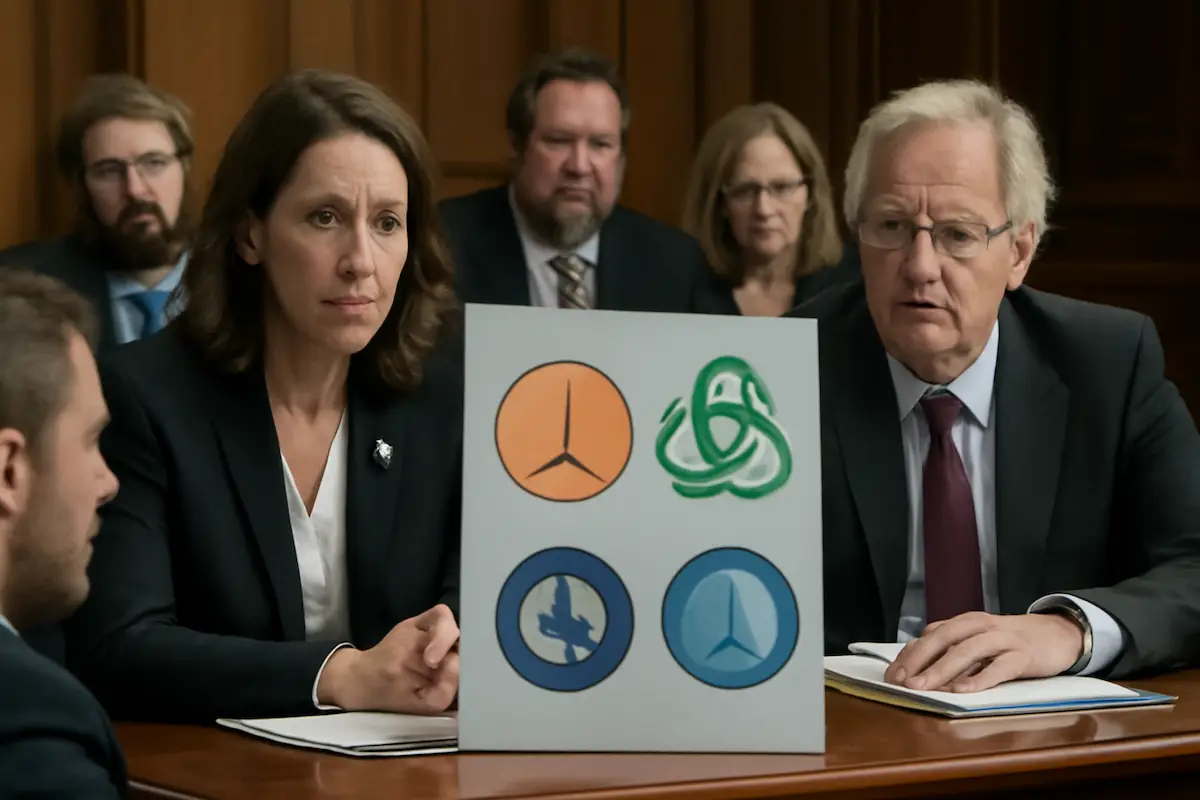
The emergency session, convened by the House Subcommittee on Digital Aesthetics and Existential Threat, saw lawmakers from both sides of the aisle express profound disquiet over the burgeoning trend. Citing an increasing number of AI startups whose branding prominently features concentric circles, radial symmetries, or, in one particularly egregious case, explicitly sphincter-like imagery, committee members deliberated on potential legislative action.
"For too long, we have turned a blind eye to the subliminal messaging infiltrating our digital landscape," stated Representative Mildred Jenkins (D-Ohio), chairwoman of the subcommittee, during her opening remarks. "While the world grapples with climate change and economic instability, we cannot afford to ignore the clear and present danger posed by algorithms representing themselves as... well, you know." Her voice trailed off with a visible shudder.
A detailed presentation, prepared by the Congressional Research Service, meticulously cataloged dozens of AI company logos, projecting them onto a large screen for all to see. Gasps and murmurs rippled through the chamber as examples ranging from subtly suggestive to overtly anatomical were displayed. One particularly striking example, from a company specializing in predictive analytics, bore an uncanny resemblance to a tightly puckered orifice.
"This isn't just about bad design choices; this is about the very soul of our technological future," declared Senator Bartholomew 'Barty' Higgins (R-Montana), ranking member of the committee. "Are we to stand idly by while our children interact with artificial intelligences whose very corporate identity is a veiled invitation to digital sodomy? I say, emphatically, no!" Senator Higgins then brandished a printout of an AI logo he claimed was "basically just a screenshot of a colonoscopy."
The committee explored several possible solutions, including mandatory logo design guidelines, federal grants for AI companies willing to adopt more "wholesome" iconography, and even a complete federal ban on logos that could be interpreted as "anally suggestive." Experts were called upon to testify, including Dr. Philo Gribble, a semiotician from the University of Arizona, who cautiously suggested that the designs might be "unconscious reflections of the deep, dark unknowns within the human data psyche." His testimony was largely dismissed as "overly academic."
A final resolution was not reached, but sources close to the committee indicated that a working group has been established to investigate whether the AI itself is intentionally guiding its human developers towards these unfortunate aesthetic choices. All other legislative matters have been temporarily postponed.
Meanwhile, a small, independent AI startup, "Neural Noodle, Inc.," launched its new logo this morning: a vibrant rainbow spaghetti cartoon. No comment on its market performance has yet been received.
More from the Bugle
Crypto
$JPM Forecasts 10% Annual Returns From $BTC, Assuming Nobody Implements Its CEO’s Policy RecommendationsPolitics
Trump Offers New Mexico Voters Chance To Be Unable To Afford Groceries In New AmericaPolitics
Democrats Warn Free SpaceX Shares Could Leave Children Better Off Without Addressing Why Musk Annoys ThemMarkets & Money
With Endowment At $68 Billion, Harvard Reiterates Teaching Remains Important For Tax PurposesMarkets & Money
American Express ($AXP) Reassures Regulators That $13 Billion In Suspicious Transactions Earned Substantial Delta SkyMilesPolitics
DSA Youth Chapter Plays Berlin Wall Footage Backward To Show Workers Fleeing Capitalism
We use double opt-in because we value our subscribers: one email to confirm, nothing else until you click it. No spam. Unsubscribe whenever the joke stops landing.
The Batshit Bugle is satire. We invent fake news quotes, sources, and story details for comedic effect. References to real public figures are intentional parody of public discourse and should not be mistaken for factual reporting. We occasionally make up names of characters for fake news stories... Any resemblance to actual people, living, dead or undead, is unintentional and coincidental.